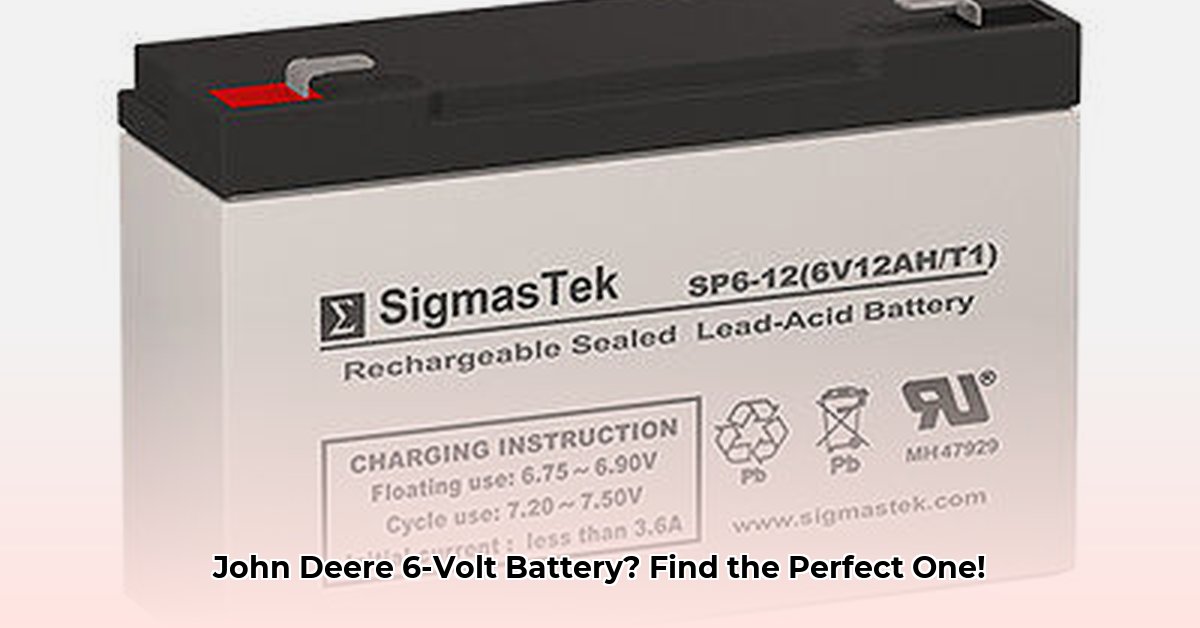
6-Volt Battery Basics for Your John Deere Tractor
Your John Deere tractor relies on a healthy 6-volt battery to power its electrical systems. This guide provides essential information on selecting, installing, maintaining, and troubleshooting this critical component. Understanding your tractor's battery needs is paramount to ensuring smooth operation and avoiding costly repairs. Did you know that a properly maintained 6-volt battery can significantly extend its lifespan, saving you money in the long run? For more information on John Deere tractors, check out this helpful resource: John Deere Tractors.
Decoding Your Tractor's Battery Needs
Before purchasing a replacement, consult your John Deere tractor's owner's manual. This vital document specifies the exact battery type, size, group size, cold-cranking amps (CCA – a measure of the battery's ability to start the engine in cold weather), and reserve capacity (RC – how long the battery can power accessories with the engine off) your tractor requires. Using the incorrect battery can cause damage to your tractor's electrical system, leading to costly repairs and downtime.
Finding the Perfect Replacement Battery
Armed with the specifications from your owner's manual, you can confidently source a replacement battery. John Deere dealerships are a reliable source for genuine parts, ensuring compatibility and often providing warranties. Online retailers like Amazon or Tractor Supply Company also offer various options, but always verify specifications before purchasing. Remember to carefully compare the specifications of the replacement battery with your owner's manual to ensure compatibility.
Installing Your New Battery: A Step-by-Step Guide
Battery installation is relatively straightforward but requires careful attention to safety:
- Locate the Battery: Identify your tractor's battery compartment (refer to your manual if needed).
- Disconnect the Negative Terminal: Loosen and remove the clamp from the negative (-) terminal first. This prevents accidental short circuits.
- Disconnect the Positive Terminal: Remove the clamp from the positive (+) terminal.
- Remove the Old Battery: Carefully lift out the old battery (it can be heavy).
- Clean the Terminals: Use a wire brush to remove corrosion from the terminals. A baking soda and water paste can help with stubborn corrosion.
- Install the New Battery: Securely place the new battery in the compartment.
- Connect the Positive Terminal: Attach the positive (+) terminal clamp.
- Connect the Negative Terminal: Attach the negative (-) terminal clamp.
Maintaining Your 6-Volt Battery: Essential Tips
Regular maintenance significantly extends your battery's lifespan:
- Check Fluid Levels (if applicable): If your battery has fluid cells, periodically check their levels and add distilled water only if necessary (consult your owner's manual). Never use tap water.
- Clean Terminals: Regularly clean the terminals with a wire brush and baking soda paste to prevent corrosion.
- Secure Battery: Ensure the battery is firmly secured to prevent movement and damage during operation.
Troubleshooting Common Battery Issues
Even with proper maintenance, problems can arise:
- Dead Battery: Check connections first. Loose or corroded terminals are common culprits. Use a voltmeter to test the battery's voltage. Low voltage may indicate a dead battery requiring replacement or a jump start. A consistently dead battery could also indicate a charging system problem.
- Slow Cranking: This usually suggests a weak battery but could also be due to corroded terminals or a faulty starter motor. Clean the terminals. If the problem persists, seek professional help.
- Corroded Terminals: Clean terminals thoroughly using a wire brush and baking soda solution. Applying a corrosion inhibitor afterwards can prevent future issues.
Battery Lifespan and Responsible Disposal
A 6-volt tractor battery typically lasts 3-5 years, depending on usage and maintenance. Proper disposal is essential. Many auto parts stores and recycling centers accept used batteries. Always check your local regulations for proper disposal procedures.
Where to Buy Your Replacement Battery
Several options exist for purchasing a replacement:
- John Deere Dealerships: Genuine John Deere parts guarantee compatibility and often include warranties.
- Online Retailers: Offer competitive pricing, but always verify compatibility.
- Local Auto Parts Stores: Convenient option with a potential broader selection.
Remember, a well-maintained 6-volt battery is crucial for your John Deere tractor's reliable operation. Following these guidelines ensures your tractor remains productive for years to come.